
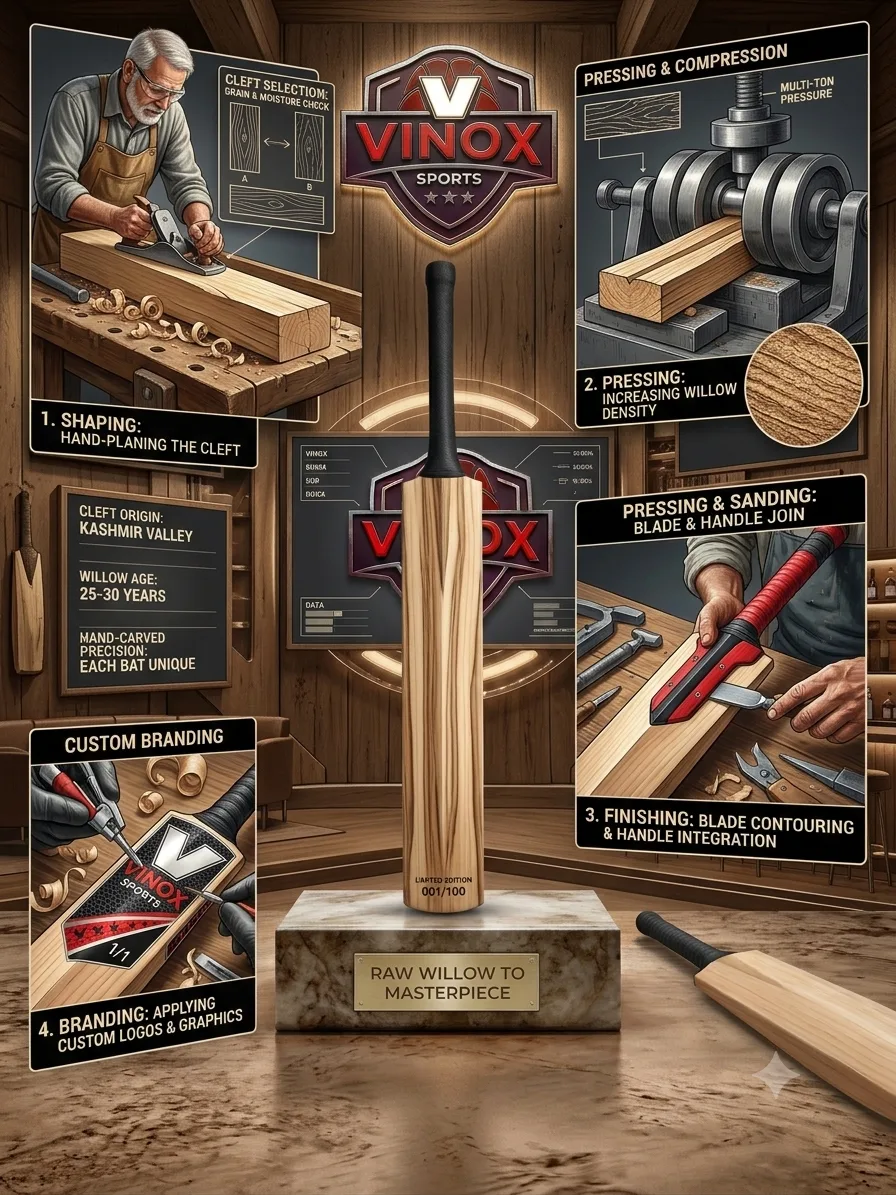
How Cricket Bats Made At Vinox Sports, we believe that a great cricketing experience begins with the quality of the wood and the craftsmanship behind every bat. A good cricket bat is not simply a piece of shaped timber; it is carefully designed to deliver balance, power, control, and confidence on the field. Whether you are choosing a Kashmiri willow cricket bat or another willow option, understanding how raw willow is transformed into a finished cricket bat will help you make a smarter buying decision.
Explore VINOX SPORTS today and find the right bat for your next cricket match!
Visit: https://vinoxsport.com/
What Is Raw Willow in Cricket Bat Manufacturing?
Raw willow is the natural wood obtained from willow trees. Before it becomes a cricket bat, it is available in the form of large wooden logs or cut sections of timber. These raw pieces contain natural grain patterns, moisture, and different wood characteristics.
However, raw willow cannot be used directly for playing cricket. It must go through several important stages, including cutting, drying, shaping, pressing, and finishing.
The quality of the original willow plays an important role in the final bat. Therefore, experienced bat makers carefully select suitable willow before starting the manufacturing process.
At Vinox Sports, we understand that the right selection of willow is the foundation of a dependable cricket bat.
How Is Raw Willow Selected for Cricket Bats?
The first step in cricket bat manufacturing is selecting the right piece of willow. Not every piece of wood is suitable for making a quality cricket bat.
Several factors are considered during selection:
Grain Structure: Straight and reasonably even grains are generally preferred for cricket bat manufacturing.
Wood Density: The density of willow affects the overall weight and feel of the bat.
Natural Defects: Excessive cracks, knots, and damaged areas should be avoided.
Moisture Content: The wood needs suitable moisture levels before further processing.
Wood Quality: The overall condition of the willow determines its suitability for a particular bat.
Once the raw willow has been selected, it is prepared for the next manufacturing stage.
Drying and Seasoning: Preparing Raw Willow
Freshly cut willow contains natural moisture. If it is shaped and used without proper drying, it may develop cracks, unwanted movement, or other problems.
Therefore, the willow is allowed to dry naturally or through controlled drying methods.
This process is commonly known as seasoning.
During seasoning:
Excess moisture is gradually reduced.
The wood becomes more stable.
The chances of moisture-related movement are reduced.
The willow becomes more suitable for shaping and pressing.
Proper seasoning is important because even beautifully shaped willow can develop problems if its moisture condition is not suitable.
Good bat manufacturing starts with properly prepared wood, not just attractive finishing.
Cutting Raw Willow into the Basic Bat Shape
This is one of the most interesting stages of cricket bat manufacturing.
After seasoning, the willow is cut into a suitable section known as a cleft. The cleft is selected according to the required bat size, blade length, and design.
Initially, the wood does not look like a finished cricket bat. It is simply a rough wooden piece.
The bat maker then starts removing unnecessary wood to create the basic outline.
The main shaping work includes:
Cutting the willow to the required length.
Identifying the front and back of the blade.
Creating the basic blade outline.
Marking the edges and shoulders.
Leaving enough wood for further shaping and balance adjustments.
At this stage, the bat begins to take its familiar cricket bat appearance.
However, it still requires careful craftsmanship before it is ready for playing.
What Is the Raw Shape of a Cricket Bat?
The raw shape of a cricket bat refers to the initial wooden structure created after cutting and basic shaping of the willow cleft.
It is not the completely finished bat. Instead, it is the foundation on which the final blade profile is developed.
A raw-shaped bat may have:
A roughly defined blade outline.
Unfinished edges.
An unpolished wooden surface.
Extra wood that needs to be removed.
An incomplete shoulder and toe profile.
A basic shape that requires further balancing.
The final shape is created by carefully removing wood from different sections of the blade.
This stage is extremely important because the amount and placement of wood influence the bat’s weight distribution, pickup, and overall playing feel.
How Is the Final Cricket Bat Shape Created?
Once the basic shape is prepared, the bat maker begins detailed shaping.
Every part of the blade has a specific purpose.
A. Bat Face
The face is the front striking surface of the bat. It is shaped to provide a suitable contact area for the ball.
B. Bat Edges
The edges are shaped to provide the required blade profile. Their size and thickness can influence the bat’s feel and performance.
C. Bat Spine
The spine is the raised central portion on the back of the blade. It contributes to the blade’s structure and weight distribution.
D. Bat Toe
The toe is the bottom section of the bat. It is shaped carefully to create a suitable finish and reduce unnecessary weight.
E. Bat Shoulders
The shoulders connect the blade to the handle. They are shaped to create a smooth transition and maintain proper balance.
A skilled bat maker removes wood carefully rather than simply making the bat look bigger. The aim is to achieve a suitable combination of strength, balance, pickup, and hitting performance.
Why Is Willow Pressing Important?
After shaping, willow is generally pressed to prepare the striking surface.
Pressing is an important manufacturing stage because it helps compress the surface fibres of the willow.
When performed correctly, it can improve the surface’s resistance to impact and help prepare the blade for match use.
However, pressing must be controlled. Excessive pressing may negatively affect the wood, while insufficient pressing may leave the surface less prepared.
The correct approach depends on the willow quality and the bat-making process.
This is why experienced craftsmanship matters when selecting a quality bat.
Handle Fitting and Final Finishing
The handle is another important component of a cricket bat. It helps players maintain control, comfort, and grip while playing different shots.
A suitable cane handle is fitted into the prepared handle area using an appropriate jointing process.
Different handle constructions are available, including multi-piece cane handles and three-piece or three-ply constructions, depending on the design.
After handle fitting, the bat goes through further finishing work:
Edge and shoulder refinement.
Toe finishing.
Sanding and surface smoothing.
Protective finishing, where required.
Grip fitting.
Final inspection and weight checking.
The bat is then prepared for quality checks before it reaches the customer.
What Are the Advantages of a Properly Shaped Cricket Bat?
A properly shaped bat offers several benefits to players.
1. Better Pickup: Correct weight distribution can make the bat feel lighter and easier to swing.
2. Improved Balance: A well-designed blade helps players maintain control during shots.
3. Comfortable Handling: Proper shoulder and handle construction can improve the overall playing experience.
4. Suitable Sweet Spot: The blade profile and willow structure influence the location and feel of the hitting area.
5. Better Playing Confidence: A bat that feels comfortable allows players to focus more on their technique.
6. Consistent Performance: Suitable willow selection, pressing, and finishing contribute to a dependable playing experience.
Remember, a thick-looking blade does not automatically mean a better cricket bat. Balance, pickup, willow quality, and craftsmanship are equally important.
How Can You Identify a Properly Shaped Cricket Bat?
Before purchasing a bat, you should understand a few basic inspection points.
Here is what you should check:
Grains: Look for reasonably straight and consistent grain patterns on the face.
Blade Profile: Check whether the spine, edges, shoulders, and toe have a smooth and balanced finish.
Surface: The bat should not have unexplained deep cracks or major finishing defects.
Pickup: Hold the bat and swing it gently to understand how its weight feels.
Handle: Check that the handle is fitted properly and does not feel loose.
Balance: The bat should feel comfortable when held in your normal batting position.
Weight: Select a weight that matches your strength, playing style, and batting technique.
One important thing to remember is that the number of grains alone cannot determine the quality of a cricket bat. Willow quality, moisture condition, density, pressing, and workmanship also matter.
Which Type of Cricket Bat Should You Choose?
Different players have different requirements. Therefore, the right bat depends on the type of cricket you play.
Leather Ball Cricket: Choose a suitable willow bat with a blade profile and weight that match your playing style.
Hard Tennis Ball Cricket: A suitable hard tennis cricket bat should offer a comfortable grip, balanced pickup, and a profile designed for tennis ball cricket.
Soft Tennis Ball Cricket: A lightweight design can help beginners and casual players improve their shot control.
Practice Cricket: Choose a durable bat that matches your practice requirements.
Players looking for a hard tennis cricket bat made from Kashmiri willow can also explore different blade profiles and handle constructions.
Similarly, a soft tennis Kashmiri willow cricket bat may be suitable for players who prefer a wooden bat for lighter tennis-ball cricket.
For players who prefer a traditional wooden feel, a kane handle cricket bat can be considered according to its handle construction and overall comfort.
Why Choose Vinox Sports for Your Next Cricket Bat?
At Vinox Sports, we understand that every player wants a bat that feels right in their hands and supports their style of cricket.
That is why attention to willow selection, blade shaping, handle construction, finishing, and overall balance is important in our approach to cricket equipment.
Here is what makes Vinox Sports worth exploring:
Carefully Selected Willow: Suitable willow options are considered according to the product range.
Player-Focused Designs: Different bat profiles are available to suit different playing preferences.
Balanced Construction: Weight distribution and pickup are important considerations.
Comfortable Handles: Handle construction and grip are considered for better handling.
Attention to Finishing: Blade shape, edges, shoulders, and toe finishing contribute to the overall appearance.
Options for Different Players: Explore wooden bats and different cricket equipment for beginners, practice players, and experienced cricketers.
Whether you are looking for a natural willow bat, a hard tennis cricket bat, or a bat for regular practice, Vinox Sports offers options worth exploring.
We believe that the right bat is not just about appearance. It is about the wood, the craftsmanship, the balance, and the confidence it gives a player.
Conclusion
The journey from raw willow to a finished cricket bat involves much more than cutting a piece of wood into a particular shape. It requires careful willow selection, seasoning, cutting, shaping, pressing, handle fitting, and finishing.
Every stage contributes to the final appearance, balance, pickup, and playing feel of the bat.
Therefore, before purchasing your next bat, pay attention to the willow quality, blade profile, grains, handle construction, and overall balance.
Explore the world of cricket equipment with Vinox Sports and find a cricket bat that matches your playing style.
Visit https://vinoxsport.com/ to explore our cricket bat collection and take your game forward with the right equipment.

 No products in the cart.